The Clock 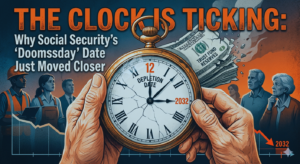
For millions of Americans, Social Security isn’t just a line item on a paycheck—it’s the bedrock of a stable retirement. But a new analysis has sent a ripple of unease through the retiree community. The Penn Wharton Budget Model (PWBM) recently updated its projections, and the news isn’t what anyone wanted to hear: the main retirement trust fund is now on track to be depleted by 2032.
That is one year earlier than the Social Security Administration (SSA) trustees’ previous estimate of 2033. While a single year might seem like a small adjustment, for those nearing retirement, it represents a rapidly shrinking window for Congress to act.
What Happens in 2032? (It’s Not a Total Wipeout)
There is a common misconception that if the trust fund “runs out,” the checks simply stop. That is not true. Social Security is primarily a “pay-as-you-go” system. Even if the reserves in the Old-Age and Survivors Insurance (OASI) Trust Fund hit zero, the program will still be collecting money through payroll taxes from current workers. However, it will only be able to pay out what it takes in.
Here is the breakdown of the potential “haircut” your benefits could take:
The 77% Scenario: The SSA trustees estimate that incoming tax revenue would cover roughly 77% of scheduled benefits.
The CBO Warning: The Congressional Budget Office (CBO) is even more cautious, suggesting the cut could be closer to 28%.
The Real-World Impact
To put those percentages into dollars, let’s look at a retiree receiving a $2,000 monthly check:
A 23% cut drops that check to $1,540.
A 28% cut drops it to $1,440.
Losing $460 to $560 every single month is a staggering blow to any household budget, especially for those who rely on Social Security for the bulk of their income.
Why the Goalposts Moved
Why did the depletion date jump forward? It’s a combination of demographic perfect .storms
Lower Birth Rates: Newer data shows fertility rates falling faster than previously projected. Fewer babies today means fewer workers paying into the system twenty years from now.
Immigration Shifts: Recent CBO and Brookings reports note that changes in immigration levels impact the “support ratio.” Because many immigrants arrive at working age, they contribute to the system for years before they are eligible to draw from it. A slowdown in this labor force growth puts more pressure on the existing fund.
The Aging Surge: The “silver tsunami” of Baby Boomers retiring continues to outpace the number of younger workers entering the workforce.
What Can You Do Now?
While the math looks grim, it’s important to remember that this is a policy choice, not an inevitability. Congress has stepped in to save Social Security before (most notably in 1983), and they have several “levers” they can pull:
Increasing the payroll tax rate.
Raising or eliminating the “taxable maximum” (the cap on income subject to Social Security taxes).
Gradually increasing the full retirement age for younger workers.
For the individual retiree or pre-retiree:
Stress-test your plan: If you are currently planning your retirement, run your numbers assuming a 20%–25% reduction in benefits. Do you have enough in your 401(k) or IRA to bridge that gap?
Delay if you can: If you haven’t claimed yet, waiting until age 70 increases your base benefit significantly, which provides a larger “buffer” even if an across-the-board cut occurs.
Stay Informed: The 2032 date is a projection, not a fixed law. As we approach the next few election cycles, Social Security reform will likely move from a “tomorrow problem” to a “today problem.”
The bottom line: Social Security isn’t going away, but it is changing. The sooner you understand the potential gaps, the more time you have to adjust your sails.
Understanding the 23% Social Security benefit cut